
Blandy's / Sustainability
Sustainability
Report
The Madeira Wine industry, over hundreds of years, has always played an important role on the island and we are very fortunate to be part of that history. As a family business with over more than 210 years of experience, we are always looking at ways to ensure that the business is passed on the next generation in the best state possible.
In recent times, we have had to become much more aware of the rapid changes required to defend the sustainability of the business and to safeguard the social, environmental, and economic impact that this industry has on the island. We have a commitment to work with all of our stakeholders to protect the future of this unique wine.
Certificates
B Corp Certified

Our journey began in March 2020, and we have been B Corp certified since December 2022. In 2026, we reinforced this commitment through our recertification, ensuring we continue to meet the rigorous standards of social and environmental performance, transparency, and accountability set by B Lab.
Certified B Corporations, or B Corps, are businesses verified by B Lab for their positive impact. This framework has allowed us to measure every aspect of our operations and implement the necessary changes to align with our vision for the future.
As a multi-generational family business, being part of the B Corp movement empowers us to ensure that we leave the company, our stakeholders, and the planet in a better place for the generations to come.
Environment-related
Certificates

This standard establishes guidelines for the quantification and reporting of greenhouse gas (GHG) emissions and removals. It is widely adopted globally, particularly by organisations committed to sustainability and environmental management, and is applied across more than 100 countries in various sectors, including manufacturing, energy, and the food and beverage industries. Furthermore, the standard promotes transparency and external verification, supporting efforts to achieve key sustainability goals.
At Madeira Wine Company, our inventory encompasses Scope 1, Scope 2, and selected Scope 3 emissions. The report is prepared in accordance with the GHG Protocol and the requirements of ISO 14064-1:2018, and is validated by an independent verifier. This rigorous process enables us to set robust reduction targets and implement concrete measures to minimise our footprint, contributing to the global commitment to reducing GHG emissions within the wine sector.
Quality Control Certificates

Obliges the company to demonstrate its ability to consistently provide products and services that meet customer and applicable statutory and regulatory requirements, and aims to enhance customer satisfaction through the effective application of the system, including processes for improvement of the system and the assurance of conformity to customer and applicable statutory and regulatory requirements.
British Retail Consortium - AA+

The BRCGS Global Food Safety Standard has set the benchmark for nearly 25 years. Adopted by over 22,000 sites in more than 130 countries, the standard is accepted by 70% of the top 10 global retailers, 60% of the top 10 quick-service restaurants, and 50% of the top 25 manufacturers.
Developed with input from industry, it provides a framework to manage product safety, integrity, legality, and quality, along with the operational controls for these criteria in the food and food ingredient manufacturing, processing, and packaging industry.
People &
Community
We have created specific HR programs for our staff at the company, that include programs on health and wellness and health risk assessment, life skills training for staff and their families, sponsored programs for continued educational credentials and external professional development opportunities. We also provide financial support to those members of staff whose children attend University. Members of the company also work on individual social projects in the less favoured communities around the island.
Through the Blandy Group, we have also developed the Blandy Academic Scholarships that are accessible to those students at the University of Madeira (UMa) who have financial difficulties and high academic performance.
Every year the group donates to a list of charitable associations, that can be found https://www.blandy.com/en/

ASAS – Ajuda Solidária Ambiental e Social
Through our social and environmental program ASAS, the Company has a 3-year plan to develop our presence on our island through environmental and social programs.
Viticulture
From 2005 onwards, the island began to see a significant decline in the production of white grape varieties, coinciding with a growing demand for both Madeira Wine and Madeiran table wines. This shortfall in production was further exacerbated by an ageing community of vine-growers and the migration of the younger generation to urban centres.
Faced with the urgent need to secure minimum yields to replenish stocks and reduce volatility in viticulture, the Madeira Wine Company established a dedicated viticulture team in 2007. The company began managing its own vineyards, starting with Quinta de Santa Luzia, owned by Andrew Blandy. Having initially planted Malvasia, Bual, Sercial, and Terrantez, the selection was later refined to Bual (the primary variety at this site), Verdelho, and Terrantez, as these varieties are best suited to the local terroir.
In the landmark year of 2011, marking the Blandy Group’s bicentenary, the company established a specific entity focused solely on the MWC’s own grape production.
This strategic move into vineyard management aimed to mitigate the challenges faced by local growers in maintaining their plots, while simultaneously ensuring the highest quality of fruit and production methods. It was in this context that Sétima Geração (7G) was born—a name that honours the seventh generation of the family to lead the Blandy legacy.
In 2013, 7G commenced operations at Quinta de São Jorge (also known as Quinta do Bispo) on the north coast, in the municipality of Santana. A vineyard of over 4 hectares was planted with a composition of 80% Malvasia, 15% Verdelho, and 5% Sercial. Since then, the company’s operations have expanded steadily, with a strong presence in the southwest of the island—within the parishes of Calheta and Fajã de Ovelha—as well as in the north, in São Jorge and Arco de São Jorge.
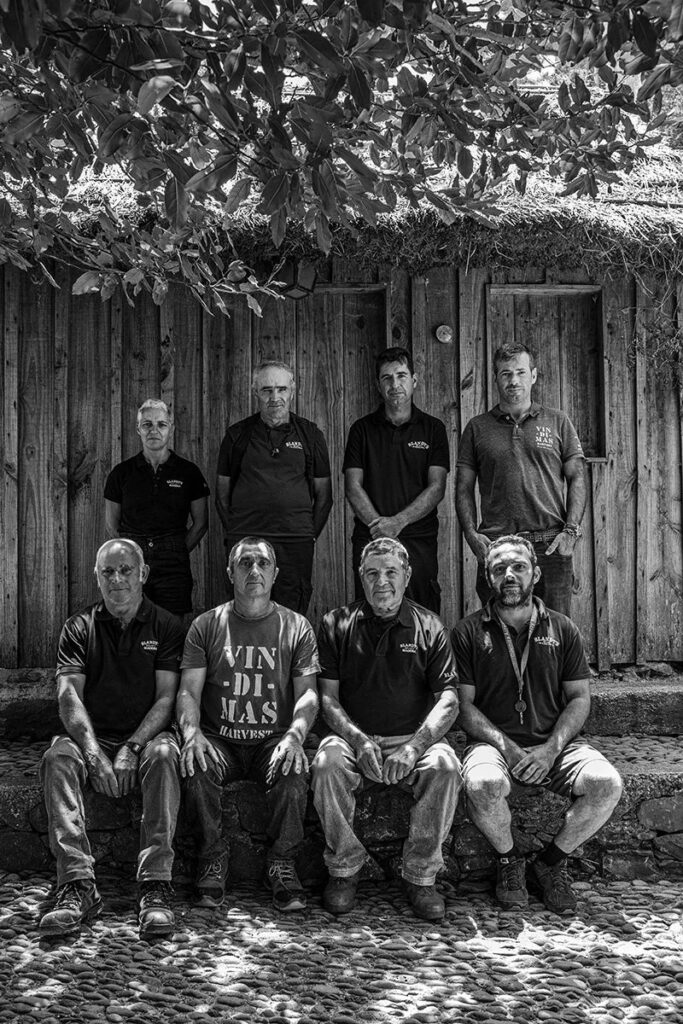
Today, the company manages approximately 10 hectares of vineyards, playing a vital role in preserving Madeira’s viticultural heritage, supporting rural communities, and ensuring the transfer of invaluable knowledge passed down through generations dedicated to their family plots.
Environmental
Sustainability
We believe that small changes have a positive impact on preserving our planet and reducing our ecological footprint. Our environmental commitment aims to promote a culture of sustainability in all stages of our operations, from grape cultivation to wine production.
Changes over the years:
- In 2014, we initiated the installation of 440 solar panels capable of producing 55,000 kWh of electricity resulting in an annual electricity reduction of 28%.
- We added 2 new solar water heating systems for use in equipment cleaning and team showers.
- We implemented a system to monitor our internal carbon footprint and regularly seek ways to improve our efficiency and reduce our carbon footprint.
- From a green mobility perspective, we are gradually transitioning company vehicles with hybrid or electric cars.
- We replaced all disposable plastics (such as coffee cups, water bottles, etc.) with sustainable alternatives.
- In 2020, we decided to change the bottle type for all our 3-year wines to a bottle that is 35% lighter. In a normal year, the total weight reduction would be approximately 61,180 kg.
- We replaced our traditional plastic T-Top cork with a wooden T-Top cork made from sustainably sourced wood.
- In 2022, we achieved B-Corp certification, reflecting high standards of environmental and social performance, with transparency and responsibility.
- In 2023, we obtained ISO14064 certification for the 2021 Carbon Footprint Report.
- We implement 100% ground cover in our vineyards, a technique that helps prevent erosion, improve nutrient retention, and capture carbon in the soil.
- Since 2021, we have been measuring the impact of our sustainable farming practices and have found that they help retain approximately 9 tCO₂e per year through ground cover.
- The biomass of the vines naturally sequesters carbon, contributing to climate resilience. Carbon sequestration through photosynthesis in our vineyards has increased from 16 tCO₂e in 2021 to 21 tCO₂e in 2023, reflecting the growing productivity of the vines.
- 7G’s agricultural emissions have decreased by 16% due to the adoption of more sustainable practices.
Sustainability and Environmental Impact Reduction Actions to be Developed in the Next 3 Years:
- Annually certify the company’s Carbon Footprint report with ISO14064 certification.
- Become a member of the International Wineries for Climate Action (IWCA) group.
- Reduce the amount of CO2 produced per liter of wine sold.
- Decrease the amount of water consumption per liter of wine sold.
- Increase the installed capacity of photovoltaic energy production.
- Ramp up the proportion of renewable energy consumption.
- Enhance energy efficiency by replacing obsolete equipment in the production area.
- Invest in the study of calculating CO2 capture from planted areas (including vineyards and other types of plantations) to determine MWC’s contribution to offsetting the impact of greenhouse gas emissions.
- Replace current lighting with LED in the Production Cellars.
- Substitute the current cold and heat production system for greater energy efficiency.
- Implement compensation projects.
- Promote awareness among employees on sustainability-related topics.
- Increase recycling of segregated waste.
- Encourage commitment from suppliers throughout the value chain.
- Reduce the weight of bottles in other wine categories.
Resource Management
Water
Monitor monthly water consumption to identify and rectify waste. Promote efficient and sustainable water use through technology investment and water reuse. Quarterly, water quality is assessed via external laboratory analyses.
Building on our existing monitoring and reuse initiatives, MWC is working towards a progressive reduction in water intensity per litre of wine produced, by improving efficiency, minimizing losses and investing in technologies that enable more sustainable water use.
Energy
Monitor monthly electricity and fossil fuel consumption to identify and rectify waste and usage issues. Promote energy efficiency including the increasing use of renewable energy (photovoltaic energy production) and investing in efficient technologies.
In addition to monthly monitoring, the company is implementing measures to reduce its energy intensity and associated greenhouse gas emissions over time, including the expansion of renewable energy consumption and the adoption of more efficient equipment and processes.
Waste Management
Monthly waste segregation monitoring to address potential recycling and valorization issues. Promote source waste reduction, by using more efficient packaging and sustainable production practices. Separate and valorize waste, incorporating composting practices.
Effluents
We conduct quarterly monitoring of the quality of the wastewater generated through external laboratory analyses.
Materials
Encourage the reduce of paper, plastic, and chemical usage by promoting sustainable alternatives. Use of lighter glass bottles to cut transportation-related carbon footprints while maintaining quality and safety standards. Monitor the market for viable, lighter, and sustainable packaging alternatives.
Carbon Footprint
Carbon Footprint 2024
As part of our commitment to sustainability, we continuously monitor our carbon footprint to minimize the environmental impact of our operations. Our emissions inventory was prepared following the GHG Protocol and ISO 14064-1:2018 standard.
Total emissions: 1.109 tCO₂e, representing a 14% reduction compared to 2022 (1.286 tCO₂e).
Scope 1 emissions: Increase of 30% (91 tCO₂e) due to propane use and refrigerant recharges.
Scope 2 emissions: Achieved a 9% reduction (135 tCO₂e) through increased use of renewable energy, covering 16% of total energy needs with on-site solar generation and sourcing 20% from green energy supplied by the local grid.
Scope 3 emissions: Reduction of 17% (883 tCO₂e) thanks to reduced emissions from input acquisition.
Efficiency Indicators
- Emissions per litre of bottled wine: Decreased by 8% to 1.46 kgCO₂e/L.
- Operational intensity (Scopes 1+2): 0.30 kgCO₂e/L, representing an increase of 36% compared to 2022 (0.22 kgCO₂e/L).
We remain committed to adopting more sustainable and innovative practices to minimize our carbon footprint and contribute to a more responsible future.
Biodiversity Promotion and Environmental Awareness
We are committed to promoting biodiversity conservation in our vineyards through sustainable practices, habitat restoration, and environmental awareness initiatives. Our approach includes:
Sustainable Vineyard Management: Eliminating herbicides, minimizing synthetic fertilizers, and encouraging cover crops between vine rows to enhance soil health and biodiversity.
Integrated Pest Management: Using insect traps for monitoring and targeted control of key pests, which helps reduce pesticide applications and protect beneficial insects and overall vineyard biodiversity.
Native Habitat Preservation: Restoring natural areas and creating shelters for indigenous species to strengthen local ecosystems.
To raise environmental awareness among employees and the community, we have implemented the following actions:
- Promotional Campaign – 21 March, World Forest Day: “1 Bottle = 1 Tree”
This customer-focused initiative resulted in 127 trees in 2024 and 79 trees in 2025, totaling 206 trees to be planted. - Tree Plantation in Partnership with IFCN-Madeira
On April 4, 2025, we planted 230 trees in a 2,300 m² area in Madeira, contributing to ecological restoration and carbon sequestration. According to IFCN estimates, this plantation will sequester approximately 53.51 tonnes of CO₂ over its lifecycle, reinforcing our commitment to sustainability and climate change mitigation. - An internal environmental awareness campaign for employees, “Seed for the Future,” addressing different topics throughout the year.